
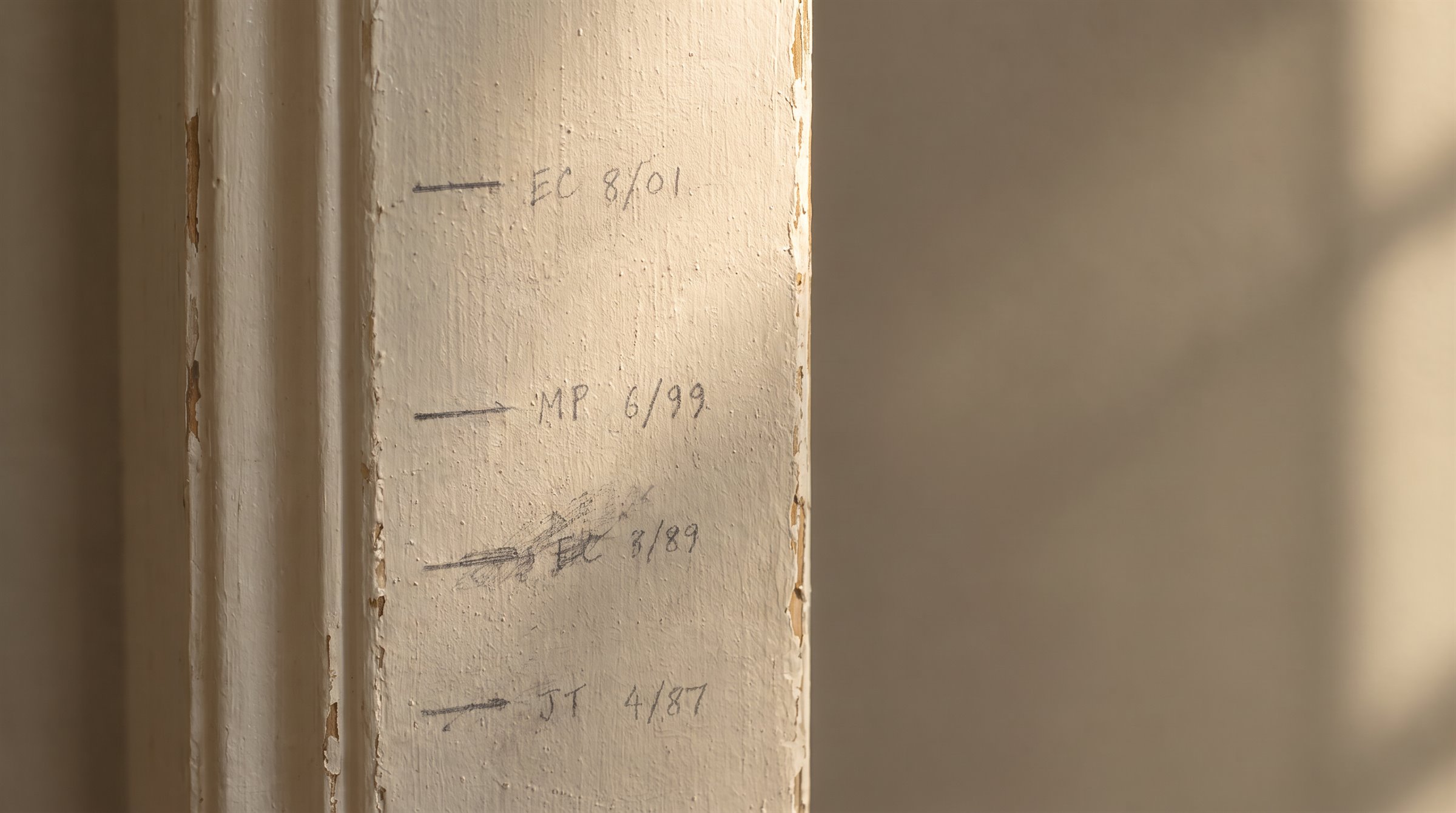
Every line on a household balance sheet can explain itself.
The retirement accounts are for retirement. The college fund is for a school, in a year someone could circle on a calendar. The cash is for the months nobody planned for. Ask any line what it is doing on the page, and it has an answer ready.
Then there is the largest number on the page.
| What it is | What it is for | The year |
|---|---|---|
| Retirement accounts | Retirement | The year you stop |
| College fund | A school | The fall it starts |
| Cash reserve | The months nobody planned for | Any year |
| The house | Everyone knows |
For most of the families I sit with, that number is the house.
It has no year on it. No purpose written beside it. In most plans I have read, it sits near the bottom as a single figure, and nobody has ever asked it the question every other line has already answered.
That is strange, once you look at it for more than a moment. It is the asset a household would least want to lose, and it is the one the plan has said the least about.
The house has a purpose. Everyone at the table knows it. It is where the children grew up. It is where the grandchildren come at the holidays. It is where you mean to grow old. Nobody needs a planner to tell them what the house is for.
What is missing is the year.
We moved into our house this spring. We built it on open land, with a lake we made and room to keep adding on, and it is still a construction project. My father and I did a lot of the work ourselves. One day, when my daughter is older, I hope she can say her dad built it together with her grandpa.
This fall I took her fishing for the first time. She is four. Mostly we threw rocks into the water and watched the monarchs come through. I want as much of that as I can get, because she is only going to be little for so long. You have until roughly eighteen, and then they are gone, and you rarely see them again.
A home is a retirement asset the way a violin is a financial instrument — technically true, and beside the point of why you own it.
Why do years matter more than dollars?
Dollars keep. Years do not.
A dollar left alone this year is still there next year. A year left alone is gone. A plan can carry money forward for decades. It cannot carry a year forward by a single day.
And nobody is told how many they have. This year a man from my gym died suddenly. He was in his mid-thirties, with two kids. It can happen to anyone. We don't know when.
Every plan is built to keep you from running out of money. Almost none is built to keep you from running out of years before the money, and the house, have been used well. That second risk is the one this essay is about.
Where do retirement plans go wrong with the house?
The house is the largest number on the balance sheet, and the place a client intends to grow old. Plans fail when they treat it as only one of those.
| Treated as a number | Treated as a home |
|---|---|
| The plan counts the equity and assumes it will be there when it is needed. | The plan leaves it out, almost out of politeness. Nobody wants to price the place the family gathers. |
| On the spreadsheet, the money is available. In the life, it is not. | The largest thing the household owns does no work for decades. |
| Liquid on paper. Immovable at the kitchen table. | No one ever decides anything about it. |
Both failures end in the same place.
When the house is never priced and never dated, the home is now the plan's shock absorber of last resort — tapped by moving, borrowing, or aging in place until the decision gets made for them.
A decision you do not make is still a decision. It gets made later, by circumstance, usually in the hardest year, and usually by someone with fewer choices than you have today. A fall. A diagnosis. A spouse who can no longer manage the stairs. The move happens in weeks, on someone else's timetable. The sale happens at whatever price that month allows. The children fly in to help decide something their parents could have decided calmly, years earlier, with every option still open.
None of it is anyone's fault. It is what happens to the one asset nobody gave a year.
Should you stay, downsize, or borrow against the house?
Stay and age in place, sell and downsize, or borrow against the house. Each one has a price, and each one has a year. Most households never see either until a hard year asks the question for them.
The useful work is refusing the either/or until the numbers have spoken — both priced honestly, each with a year attached.
| Stay | Downsize | Borrow | |
|---|---|---|---|
| What it costs | The repairs, the help, the stairs, year by year | The sale, the move, the new place | What the loan costs, and what it draws down |
| In which year | Until the house no longer fits the body | The year you choose, or the year chosen for you | The year it starts, and how long it runs |
| What it leaves | The house, and the years spent in it | The difference, and a home that fits | Less house for later, and the years it bought |
Neither path flattered.
Then comes the harder part.
Sometimes, once both paths are priced, the answer is that the household can have one or the other, and not both. The numbers do not always find a third way, and pretending they might is how the decision drifts another five years.
Sometimes it is a choice. Saying so plainly is the job.
It is the least comfortable part of the work and the part that matters most, because a choice you can see is a choice you still get to make.
We'd rather a client make that decision on paper, in a calm year, than at eighty-two in a hard one.
On paper means the decision is written down, with its year, while there are still several good answers. In a calm year means before the fall, before the diagnosis, before the move nobody chose. At eighty-two in a hard one means the same decision, made by circumstance, with one answer left.
What can a plan not fix?
None of this gives anyone a year back.
Pricing both paths does not make the hard one easy. Naming a year for the house does not mean the year arrives the way it was written. Health does not take instructions. Neither do the people we share a house with.
What the work does is narrower than that, and I think it is enough. It makes the decision yours. Made in a calm year, on paper, with the numbers already in front of you.
The rest was never in anyone's control.
So what year is my house for?
I know part of the answer. It is for the years she is small. We built it to gather people, with room for everyone to have their own space and places to come together, and it is for one Christmas I keep picturing. My parents and my sister's family across the ocean from Germany. My son home. My two nephews and my daughter running the place like a team of their own.
That Christmas has a year now. 2027. It is written down. This one, our first in the house, will be smaller, and it counts too.
There is one more year I almost let slip. Building the house took most of this one. More contractors than I want to count, and more of my attention than I planned. Somewhere in it, my son finished his first year of college, three and a half hours away, and I never made the drive. Before this year is over, I am driving up to see him there. That one gets its date this week.
I am not perfect at this. I am growing in it too.
Find the largest number on your own balance sheet.
Write a year next to it.
If you can't, that's the work.
Your own years are the place to start: the Time Inventory.
